
Is Alaska in the Arctic Circle?

Is Alaska in the Arctic Circle? How much of Alaska is in the Arctic Circle?
As the United States’ 49th state, Alaska is well known for its vast wilderness, rugged terrain, and extreme climate. But, with it being so far north parallel with that of Greenland, Iceland, and Scandinavia, the topic of whether or not any portion of the state lies within the borders of the Arctic Circle is a popular topic.
We’ve been lucky enough to drive the entirety of Alaska from top to bottom and back, with our roadside journey concluding at the northernmost town accessible by car known as Prudhoe Bay. Coming from Fairbanks, this drive takes about 13 hours (despite Google Maps saying 11.25 hours) and covers 496 miles.
We’ve traversed the Dalton Highway several times and often covered the distance in about a 48-hour period, but we’ve also successfully complete this drive in a single day.
It is true that approximately the northern third of the state lies within the Arctic Circle, making it a fantastic destination for northern lights viewing and seeing wildlife local to the Arctic tundra.
In this post, we’ve identified the exact portion of Alaska that lies within the Arctic Circle, how you can access it, and provided some quick facts about its year-round population and whether or not it’s worth visiting!
Is Alaska in the Arctic Circle?

The top third of Alaska is situated within the Arctic Circle, while a significant portion of the state extends beyond its boundaries.
Within the 49th state, the border of the Arctic Circle starts at its northernmost point, the Arctic Ocean coast, and extends southward towards Fairbanks (though it never reaches as far south as this city).
The exact location of this border shifts slightly each year due to natural changes in the Earth’s tilt, but on average, the Arctic Circle lies at 66 degrees north latitude. This includes everything north of the town of Fort Yukon, Alaska.
What is the Arctic Circle Exactly?
The Arctic Circle is an imaginary line that runs parallel to the Earth’s equator at a latitude of approximately 66.5 degrees North. This line marks the southernmost point where the sun does not set on the summer solstice and does not rise on the winter solstice.
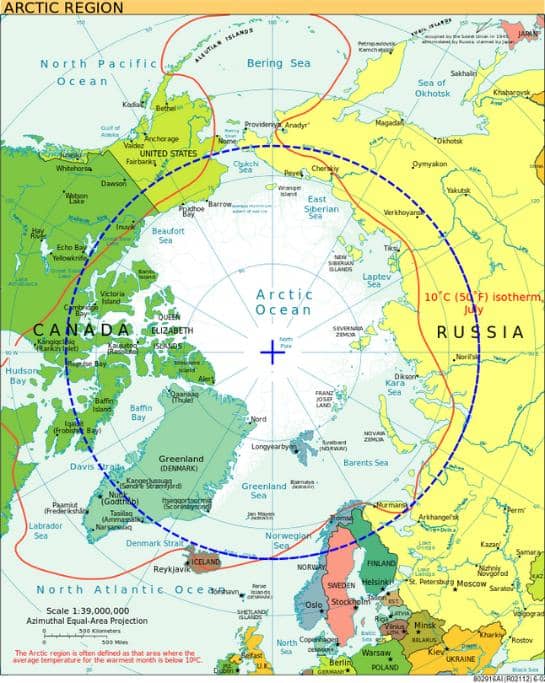
It also serves as a boundary for the Arctic region, which includes parts of eight different countries such as Canada, Greenland, Russia, Norway, Sweden, Finland, Iceland, and of course, Alaska.
This phenomenon, known as the “midnight sun,” only occurs in regions within or near the Arctic Circle. You can learn more about the phenomenon in my article: 30 Days of Night in Alaska: Polar Nights & Midnight Sun Explained.
Arctic Circle Map
Below, we’ve included a map that shows the rough outline of Alaska’s border and the location of the Arctic Circle within it. As you can see, while the northern third of the state lies within its boundaries, the majority of the state is not in the Arctic Circle.
Arctic and Antarctic Circles Definition
Paraphrased from Britannica, the Arctic Circle is an “[imaginary] line of latitude around Earth, at approximately 66°30′ North”.
Located at the exact opposite end of the Earth in the South Pole, the Antarctic Circle is an “[imaginary] line of latitude around Earth, at 66°30′ South”, also according to Britannica.
FAQ
In this next section, I’ve compiled some related information regarding Alaska and the Arctic Circle including the cities and towns it encompasses, how many people live within its borders, and more!
Is Any of Alaska in the Arctic Circle?
Yes, a significant part of Alaska is indeed in the Arctic Circle.
This includes regions in the northern part of the state, notably the North Slope Borough, with notable settlements such as Utqiaġvik (formerly known as Barrow), the northernmost town in the United States, and portions of the Northwest Arctic Borough, including the town of Kotzebue.
These areas experience the unique phenomena of the ‘midnight sun’ in summer and ‘polar night’ in winter. However, the majority of Alaskans live south of the Arctic Circle, in cities such as Anchorage and Fairbanks.
How Much of Alaska is in the Arctic Circle?
Approximately one-third of the state’s total land area falls within the Arctic Circle. This may not seem like a significant amount, but keep in mind that Alaska is the largest state in the United States, covering over 586,000 square miles!
What Alaskan City is Closest to the Arctic Circle?

Fairbanks is the largest city that is closest to the Arctic Circle. However, there are a few smaller towns and villages that do fall within its boundaries. These include Anaktuvuk Pass, Barrow (now known as Utqiagvik), Coldfoot, Fort Yukon, and Kaktovik.
Despite Fairbanks not lying within the Arctic Circle itself, it still remains one of the best cities in North America to spot the northern lights!
Can You Visit the Arctic Circle in Alaska?
Yes, you can drive to the Arctic Circle from Fairbanks! Sean and I have done it ourselves, with it taking exactly 27 days to make the journey from Boston, Massachusetts.
A popular route taken by many visitors is the Dalton Highway, also known as ‘The Haul Road’, which meanders through some of Alaska’s wildest and most remote areas. The journey from Fairbanks to the Arctic Circle sign on this road is approximately 200 miles one-way and takes about 5 to 6 hours depending on road and weather conditions.
Remember, this is a remote drive with limited services, so preparatory measures are essential. It’s advisable to carry spare tires, extra fuel, food, water, a satellite phone, and first aid supplies. Also, due to the intense weather conditions, winter travel is not recommended for casual travelers.
In the summer, however, it’s an unforgettable adventure that offers breathtaking views of the northern landscape, the Yukon River, and possibly some wildlife sightings!
Take a look at Can You Drive to Alaska Without a Passport? if you’re thinking of making the journey to the Arctic Circle from the lower 48 this upcoming summer.
Is It Worth Going to the Arctic Circle in Alaska?

Absolutely, visiting the Arctic Circle in Alaska is a truly unique experience that is well worth the challenges you’ll have to overcome to get there. This journey offers an opportunity to witness natural phenomena like the ‘midnight sun’ and ‘polar night,’ and experience a whole new level of wilderness.
You’ll be able to enjoy stunning landscapes, diverse wildlife, and the rich cultural heritage of the Indigenous people residing in these regions. During our visit, we were lucky enough to see wild muskoxen, caribou, Arctic loons, and even the elusive Arctic fox!
However, keep in mind this trip requires careful planning due to the remoteness of the area and the extreme weather conditions. Once the snow hits Deadhorse, the journey along the Dalton Highway becomes exceedingly unforgiving.
How Many People Live in Alaska Above the Arctic Circle?
While the exact number varies year by year due to various factors such as migration and birth rates, it’s estimated that around 7,000 people currently reside above the Arctic Circle in Alaska.
Most of these individuals live in small, rural communities like Utqiaġvik (formerly known as Barrow), Kotzebue, and several small villages.
These communities have adapted to the harsh Arctic conditions over countless generations, and they continue to follow a subsistence lifestyle that heavily depends on hunting, fishing, and gathering.
Is Fairbanks in the Arctic Circle?
No, Fairbanks is not in the Arctic Circle. While it is the largest city nearest to the Arctic Circle, it’s located approximately 194 miles south of it by roadway.
However, due to its high latitude, Fairbanks still experiences the fascinating natural phenomena of nearly 24 hours of daylight in the summer and extended nights in the winter.
Having lived in Fairbanks throughout the winter ourselves in the frigid temperatures, we loved how the sun would barely rise above the horizon line around 11AM in mid-December creating a beautiful blood orange sky just to fall immediately back down again.
Is Juneau Alaska in the Arctic Circle?

No, Juneau, the capital of Alaska, is not located in the Arctic Circle. Situated in the Southeast region of the state, Juneau is approximately 923 miles south of the Arctic Circle.
Despite its relatively southern location by Alaskan standards, Juneau still offers stunning natural beauty, a wealth of outdoor activities including whale watching tours and glacier hikes, and a taste of Alaskan wilderness.
Plus, it’s the only U.S. capital only accessible by plane or boat!
Is Nome, Alaska Above the Arctic Circle?
No, Nome lies below the Arctic Circle. It is located in the far western reaches of the state, nearly parallel with Fairbanks.
Despite it lying outside of the Arctic Circle, Nome still offers exceptional Arctic activities like ice fishing, northern lights viewing, snowmobiling, and more!
What is the Arctic Circle’s Latitude?
The latitude of the Arctic Circle is approximately 66.5 degrees North.
This invisible geographic boundary is defined as the southernmost latitude in the Northern Hemisphere at which the sun can remain continuously above or below the horizon for 24 hours – these phenomena are known as the Midnight Sun in the summer and the Polar Night in the winter.
It’s an ever-so-slight shift, but the exact location of the Arctic Circle is not fixed; due to axial tilt, it moves by a few meters each year.
Do Any States Touch the Arctic Circle?

The only U.S. state that touches the Arctic Circle is Alaska. The contiguous U.S., also know as “the lower 48”, lies beneath Canada thousands of miles below the Arctic Circle.
While this may seem inconvenient to those wanting to visit, it only makes Alaska that much more admirable to inspired travelers.
What are the Arctic Circle Countries?
The countries that touch the Arctic Circle include the United States, Canada, Greenland, Iceland (Grímsey Island) Norway, Sweden, Finland, and Russia.
The countries with the largest amount of land mass within the Arctic Circle are Russia, Canada, and Greenland (owned by Denmark).
So, is Alaska in the Arctic Circle? The answer is both yes and no! The Last Frontier encompasses regions both above and below the Arctic Circle, making it a fascinating destination to explore the diverse landscapes and cultures that this region has to offer.


