
Can You Drive to Alaska from the United States?

Can you drive to Alaska from the United States? Can you get to Alaska without going through Canada?
With our trunk and roof racks packed to the brim and our dog seat belted in the back, we set out on an 8,000+ mile journey from Boston, Massachusetts to Prudhoe Bay, Alaska, deep within the Arctic Circle. We drove from the United States’ lower 48 to Alaska, and we’re here to teach you exactly how to do it yourself!
Along the 27-day journey, we slept in the sand dunes of Montana, hiked the Canadian Rockies in Banff National Park and Jasper National Park (among many others), started the Alaska Highway at Mile 0 in Dawson Creek, and even woke up to wolves just a mile outside of our camp on Muncho Lake in British Columbia!
We road-tripped over 35,000 miles across North America, and have provided you with everything you need to know about driving to Alaska from the contiguous United States.
From the road conditions and cell phone service to the best national parks to stop at along the way, this is your complete guide to traveling to Alaska via car.
Can You Drive to Alaska from the United States?

Yes, you can absolutely drive to Alaska from the United States by driving through Canada’s British Columbia and Yukon territories. We know, because we’ve done it!
Depending on which state you’ll be departing from, you’ll have several options for making your way across the Canadian border and into the 49th state.
The most commonly taken route is the Alaska Highway, also known as the Alcan Highway, which runs from Dawson Creek in British Columbia, Canada, to Delta Junction near Fairbanks, Alaska.
It’s a well-traveled highway that stretches approximately 1,387 miles and the road conditions are typically quite good, though winter conditions can vary greatly. We found that the closer we got to Alaska, the worse the road conditions became.
Two lanes often became one due to 3-foot wide potholes or washed out shoulders, so it’s important to keep an eye on the road while driving.
Travel Tips for Driving to Alaska from the Lower 48

Driving to Alaska isn’t a small journey by any means, so we’ve provided you with all of our top travel tips from our experience as well as dozens of other travelers we met along the way!
Prepare Your Vehicle
- Regular Maintenance: Before your journey, ensure your vehicle has undergone a thorough check-up! We brought our Subaru Forester in for an oil change, had the alignment checked, and had a complete inspection done before hopping on the road.
- Spare Tires and Emergency Kit: Carry at least one full-sized spare tire and an emergency kit including jumper cables, flares, tools, and extra car fluids. It’s also not a bad idea to learn how to change a tire before leaving your driveway, so you don’t end up watching a YouTube video on the side of the highway.
- Roof Racks: Fantastic if you need some extra space, but you won’t be able to drive as fast and they do affect gas mileage (varies by car), so keep this in mind if you’re debating having them installed. We had a Thule cargo carrier on our roof racks and absolutely loved it!
Documentation and Crossing Borders
- Passport and Identification: Always carry your passport or a NEXUS card for border crossings between the U.S. and Canada. It’s also a good idea to keep an eye on the Canadian Government website for any updates to border crossing requirements. Since we had a dog, we also had to provide proof of her rabies vaccination.
- Vehicle Paperwork: Keep your vehicle registration and proof of insurance handy, as border officials or local police may ask for these documents.
Navigation and Communication
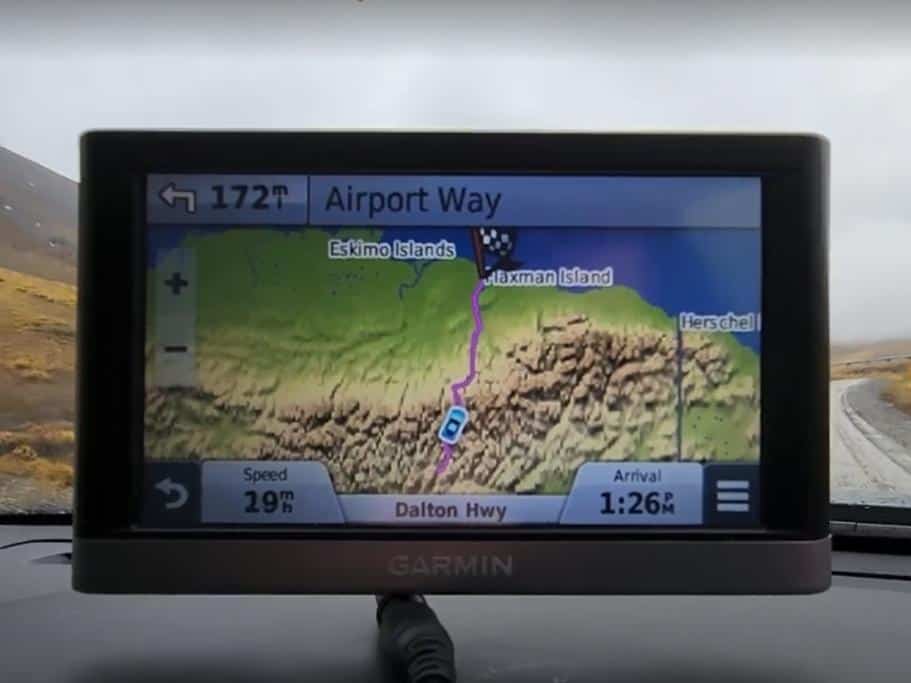
- Offline Maps: Download offline maps since you may encounter long stretches with no cell service. We purchased a car GPS like this one as well as the North America map so even if our phones didn’t have service or ran out of battery, we also had this GPS that worked well with no signal.
- Satellite Phone or Communicator: Consider renting or purchasing a satellite phone or a GPS communicator for emergency contact in remote locations. We didn’t do this, but along the Dalton Highway, we met several people who had satellite phones for the 13-hour drive with no cell service!
Road Conditions and Safety
- Expect Varied Road Quality: The highways can range from smooth pavement to challenging gravel patches, loose dirt, soft and washed out shoulders, and massive pothole-covered “roads”. If you will be in an area with road cameras, you should try staying updated on road conditions, especially during the winter months.
- Wildlife Awareness: Be vigilant for wildlife crossing the road, particularly at dawn and dusk when animals are most active. Especially in British Columbia and the Yukon Territory, we came across bison, wolves, coyotes, foxes, deer, big-horned sheep, moose, bobcats, lynx, and bears on the road! The wildlife viewing was our favorite part of the entire trip, so have your camera ready up front with you.
Fuel and Accommodations
- Frequent Refueling: Gas stations can be few and far between, so fill up your tank regularly and carry extra gas with you (on the outside of the vehicle). Even if you’re at three-quarters of a tank, get the gas anyway. We filled up almost every time we saw a gas station, and we still had a couple of close calls since we weren’t carrying extra fuel with us!
- Lodging and Camping Reservations: Plan your lodging ahead of time or carry camping equipment if you prefer to stay outdoors, as accommodations in certain areas can be limited. Just keep in mind that dispersed (free) camping is only allowed in certain areas, and you will be fined for sleeping in your car or tent in an unauthorized area.
Personal Comfort and Needs
- Food and Water Supplies: Stock ample food and water supplies for parts of your journey with no services. We always kept dry goods in the car, and if you have the room, a Jetboil like this one can allow you to cook hot meals in a flash.
- Layers and Weather-Appropriate Clothing: Weather can be unpredictable, so bring clothing layers that can accommodate a wide temperature range. Always keep extra jackets, blankets, hats, gloves, and thermal socks in your car in case you get stuck.
- Toilet Paper and Hand Sanitizer: You will go hundreds of miles without finding a real bathroom on parts of this journey, particularly if you’re coming all the way from the east coast like we were. When nature calls, toilet paper and hand sanitizer will be your best friend!
Enjoying the Scenic Route

- Plan for Stops: Include time in your itinerary to enjoy the scenic viewpoints, sleepover in national parks, and enjoy wildlife sightings along the way. We visited 20 different national parks on our North America road trip and we don’t regret a single day.
- Keep a Journal: Document your journey with photos and a travel journal—this is a bucket-list road trip to remember!
- Purchase the Most Current Version of The Milepost: This book saved us on too many occasions to count. From pull-offs to gas stations and where to look out for wildlife, this is the ultimate guide to driving to Alaska!
Driving Through Canada to Alaska Requirements
While Alaska is part of the United States, there is no uninterrupted land route that bypasses Canada, making it necessary to carry a valid passport or other appropriate documentation such as a NEXUS card, especially when entering through Canadian customs.
Depending on your nationality, you may also need to obtain a visa or other approved travel documentation showing your ability to pass between the U.S. and Canada. It’s best to check with your local embassy or on your own government’s website to ensure that you arrive with the necessary documentation for a successful trip.
On the other hand, if you are a member of the U.S. Armed Forces on official orders or a U.S. lawful permanent resident with a green card, you may be allowed pass freely between the U.S. and Canada.
Regardless, it’s always best to check the latest requirements with U.S. Customs and Border Protection as well as the Canada Border Services Agency before planning your trip.
If you will be traveling with a pet, you may also need to show their vaccine records and prove that they have a current rabies vaccine.
For a more detailed explanation of the requirements for entering Canada, you can check out Can You Drive to Alaska Without a Passport?
Road Trip to Alaska Map
The map below highlights everywhere we stayed on our drive to the northern tip of Alaska from the lower 48. The drive took us 27 days, but we also spent 4 nights sleeping between Banff and Jasper National Parks, 3 nights in Colorado, and so forth.
We also spent quite a bit of time enjoying over 20 national parks between the out and back trip, so we certainly added extra time to the drive!
The drive can certainly be done in less time, but we also had our dog in tow which required us to stop more often for food and potty breaks. If you were to depart from a state closer to British Columbia or Alberta, then you could likely do the drive in 10 days or less!
Once we entered Canada, it only took us 7 days to get to Alcan Border, but again, you could likely do it 3 days if you wanted to.
FAQ
In this next section, we’ve answered some helpful questions for your road trip to Alaska from the lower 48 including if you have to cross the Canadian border, if it’s worth it to drive to the Last Frontier, how safe the journey is, and even our preferred routes!
Can You Travel to Alaska by Car?
Absolutely, you can travel Alaska by car from the contiguous United States, but it will require driving through Canada.
There are no water crossings along the typical journey, however, anyone wishing to drive to Juneau or other water-bound destinations like Sitka or Gustavus (borders Glacier Bay National Park) will have to either board a ferry or plane to complete their trip.
Can You Drive to Alaska Without Going Through Canada?

No, if you’re driving from the lower 48 states to Alaska, you cannot avoid traveling through Canada. The only land routes to Alaska pass through one, if not two, Canadian territories including British Columbia and the Yukon.
However, for those looking to bypass the road trip through Canada, you can consider transporting your vehicle by ferry via the Alaska Marine Highway System or shipping your car and flying to your destination in Alaska!
Can You Drive to Alaska from California?
Yes, driving to Alaska from California is entirely possible. The adventure typically begins on I-5 North and continues through the beautiful states of Oregon and Washington before crossing the Canadian border.
We drove from Alaska to California in about 6 days, driving between 400 and 600 miles per day.
It is a long drive—over 3,000 miles from San Francisco to Anchorage—so be prepared for several days on the road and varying driving conditions, particularly as you navigate through British Columbia and the Yukon Territory en route to Alaska.
Can You Drive from Florida to Alaska?

Indeed, it is possible to drive from Florida to Alaska, although you should be prepared for a multi-week cross-country odyssey that will take you through a multitude of climates, terrain, and scenic landscapes.
This journey spans nearly 5,000 miles, and you’ll traverse the height of the continental United States before entering Canada and making your way to Alaska. Driving from Miami to Anchorage, for example, might take you approximately three weeks or more, depending on the number of stops you make along the way.
While it is entirely possible, it’s definitely an epic road trip that requires thorough preparation and planning.
Is It Worth It to Drive to Alaska?
Not only is driving to Alaska well worth it, but it was also one of the most epic adventures we’ve ever embarked on.
The journey is as rewarding as the destination itself, with countless opportunities to spot wildlife in its natural habitat, go hiking in national parks, check out charming towns often overlooked on tourist maps, and just immerse yourself in the breathtaking scenery found throughout North America along the way!
While the road might be demanding at times and figuring out where to sleep night after night can be exhausting, we don’t regret a single memory. The good, the bad, and the ugly taught us so much about appreciating the travel opportunities we had all along right in our own “backyard.”
After traveling all over the world to dozens of countries, we still talk about the wolves in British Columbia, the glacial lakes in Banff and Jasper, the mountains in Colorado, and of course, the northern lights in Alaska!
Is It Safe to Drive to Alaska?

Traveling to Alaska by car is generally safe, but it requires careful planning and awareness of the unique driving conditions you may face. The roads, particularly through Canada and near the Alaskan borders (we’re talking about you, Alcan Border), can be remote and challenging, with fewer services available.
It’s essential to have a well-maintained vehicle, carry extra food and supplies, and be prepared for potential wildlife encounters as shown on the sign we camped next to above. Weather conditions can also be unpredictable, so drivers should stay informed about forecasts and road closures.
As for the people you may come across, it’s a total toss-up. Some states are safer than others, with California and New Mexico remaining the most dangerous in the country. It’s best to do some thorough research on whichever area you plan on staying in to ensure it’s safe for you to spend the night.
When in doubt, move on to the next rest stop! It’s also good practice to keep emergency numbers handy and let someone know your travel plans. With the right preparation, the journey to Alaska can be a safe and unforgettable experience.
How Long Does it Take to Drive to Alaska?
Generally, from the contiguous United States, you can expect the drive to take anywhere from 4 to 10 days if you’re driving with minimal stops. However, the duration of a road trip to Alaska can vary greatly depending on your starting point, the route taken, driving conditions, and the number of stops you plan along the way.
If you’re embarking on a more leisurely journey, with stops to explore attractions or rest like we did, then the trip could take 2 weeks or more! It’s important to consider factors such as weather, road conditions, and construction, as they can significantly affect travel time, as well.
Overall, it took us 27 days to reach Deadhorse in the Arctic Circle, but we were making considerable stops for 2 or 3 nights at a time, with 4 nights spent between Banff and Jasper National Parks.
What is the Best Route to Drive to Alaska?
The best route for driving to Alaska will depend greatly on your starting location and preferences for sightseeing along the way.
However, the most common and direct route is the Alaskan Highway which starts in Dawson Creek, British Columbia, and runs to Delta Junction which is just 95 miles southeast of Fairbanks.
Regardless of the route you choose, we recommend including scenic stops along the way to get the most out of your Alaska road trip!
How Much Does It Cost to Drive to Alaska?

Calculating the cost of driving to Alaska depends on several variables, including your vehicle’s fuel efficiency, the distance you need to travel, the price of fuel along your route, the cost of food and beverages, etc.
Additionally, accommodations and unexpected expenses such as vehicle maintenance or roadside assistance can add up. On our journey, daily expenditures for gas ranged from $30 to $100, taking the fluctuating gas prices into account.
Lodging costs varied widely, from $0 for nights spent in dispersed camping areas to upwards of $130 for a comfortable hotel room or Airbnb. By preparing meals ourselves while camping and purchasing ready-made foods from local grocery stores, we saved considerably, though we occasionally treated ourselves to local cuisine for about $25 to $40 per meal.
Overall, our entire 27-day road trip to Alaska cost us roughly $2,000, not including the cost of installing the roof racks, getting new tires, etc.
Is There Cell Service on the Highway from the U.S. to Alaska?
Cell service on the highway to Alaska through Canada is patchy and can be quite unreliable, especially as you travel through remote areas. While major towns and cities along the Alaskan Highway will generally have coverage, there are long stretches between these points where you may find yourself without service.
Some U.S. cell providers do cover parts of Canada and Alaska, but it’s crucial to check with your provider about roaming charges and service availability.
We recommend downloading offline maps and travel guides ahead of time, and consider purchasing an unlimited data plan and mobile hotspot if you need to ensure constant communication for safety or work purposes.
While you can certainly drive from the U.S. to Alaska, it require proper planning, preparation, and a sense of adventure! A road trip to Alaska provides every opportunity to be an incredible journey you won’t soon forget. Just remember to stay informed, drive carefully, and enjoy the breathtaking landscapes along the way.
Up next, be sure to read our Essential Guide to Traveling to Alaska!


